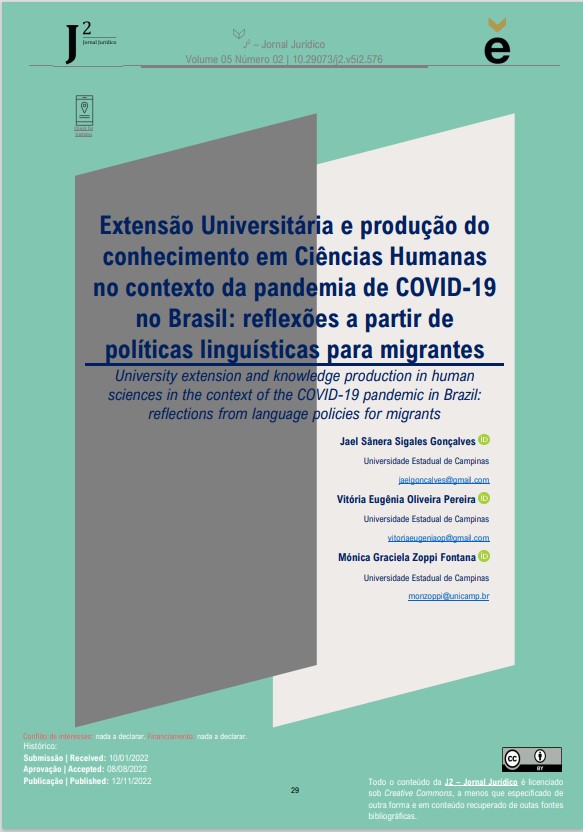
University extension and knowledge production in human sciences in the context of the COVID-19 pandemic in Brazil: reflections from language policies for migrants
Article Sidebar
Main Article Content
Abstract
The sanitary crisis installed by the COVID19 pandemic affected Brazil in a particularly intense way, the result of an alliance between political and economic interests that resulted in a simultaneous attack on science and human rights. Brazilian universities are paradoxically at the center of this scenario: on the one hand, they receive from the legal system the mission of acting in the production of scientific knowledge and in the development of society; on the other hand, they are targets in the neoliberal denial that materializes through the reduction of investments and affects, mainly, the material conditions of existence of the Human Sciences. In this scenario, we discuss the role that university extension in Human Sciences plays by placing the University at the center of resistance against human rights violations during the pandemic. We present concrete examples in the field of language policies, showing extension actions aimed at the realization of linguistic human rights (SKUTNABB-KANGAS; PHILLIPSON, 1994) of migrants in the context of the pandemic. We are committed to a critical approach to human rights (HERRERA FLORES, 2009) that allows us to suspend the transparency of legal human rights norms (ORLANDI, 2008; MASCARO, 2002; 2017) and reflect on the place of extension in the Human Sciences, specifically in linguistic policies, in the "University in the 21st century" (SANTOS, 2011).
Downloads
Article Details

This work is licensed under a Creative Commons Attribution 4.0 International License.


References
Agência da ONU para Refugiados (ACNUR). (2019). Perfil socioeconômico dos refugiados no Brasil: subsídios para elaboração de políticas. Recuperado em: https://www.acnur.org/portugues/wp-content/uploads/2019/05/Resumo-Executivo-Versa%CC%83o-Online.pdf.
Baeninger, R., & Peres, R. G. (2017). Migração de Crise: a migração haitiana para o Brasil. Revista Brasileira De Estudos de População, 34, 119-143. Ok
Mascaro, A. L. B. (2002). Sobre os direitos humanos e sua tutela. Revista da Faculdade de Direito, Universidade de São Paulo, 97, 267-278.
Orlandi, E. L. P. (2008). Educação em direitos humanos: um discurso. In Silveira, R. R. M. G. et al. (Org.). Educação em direitos humanos: fundamentos teórico-metodológicos. (1ª ed., pp. 295-311). Editora Universitária.
Pêcheux, M. (2011). As ciências humanas e o momento atual. In Orlandi, E (Ed.). Análise do discurso. Michel Pêcheux. (1ª ed., pp. 175-202). Pontes.
Pereira, V. E. (2019). A história da universidade no Brasil e o processo de Gramatização brasileira. In Luciana Nogueira et al. (Orgs.). Univás.
Portal do Centro de Letras e Comunicação UFPEL. (30 de março. 2022). CLC cria projeto para tradução, assessoramento linguístico e disseminação de informações sobre a COVID-19, Recuperado em:
Resolução nº 7, de 18 de dezembro de 2018. (2018). Estabelece as Diretrizes para a Extensão na Educação Superior Brasileira e regimenta o disposto na Meta 12.7 da Lei nº 13.005/2014, que aprova o Plano Nacional de Educação – PNE 2014 – 2024 e dá outras providências. Ministério da Educação, Conselho Nacional de Educação, Câmara de Educação Superior. Recuperado em: http://portal.mec.gov.br/index.php?option=com_docman&view=download&alias=104251rces007-18&category_ slug=dezembro-2018-pdf&Itemid=30192
Santos, B. S. (2004). A Universidade no século XXI: para uma reforma democrática e emancipatória da Universidade. Cortez.
Sigales-Gonçalves, J. S. (2008). Direitos linguísticos no acesso ao direito à educação por migrantes forçados no Brasil: Estado, práticas e educação superior. [Dissertação de Mestrado em Direito, Universidade Federal de Pelotas].
Skutnabb-Kangas, T., & Phillipson, R. (1994). Linguistic human rights, past and present. In Skutnabb-
Kangas, T., & Phillipson, R., & RANUT, M. (Eds.), Language rights. (Vol. 1, pp. 71-110). Routledge.
Zoppi-Fontana, M. G. (2009). Apresentação. In Zoppi-Fontana, M. G. (Org), O Português do Brasil como Língua Transnaciona (pp. 13-41) RG Editora.