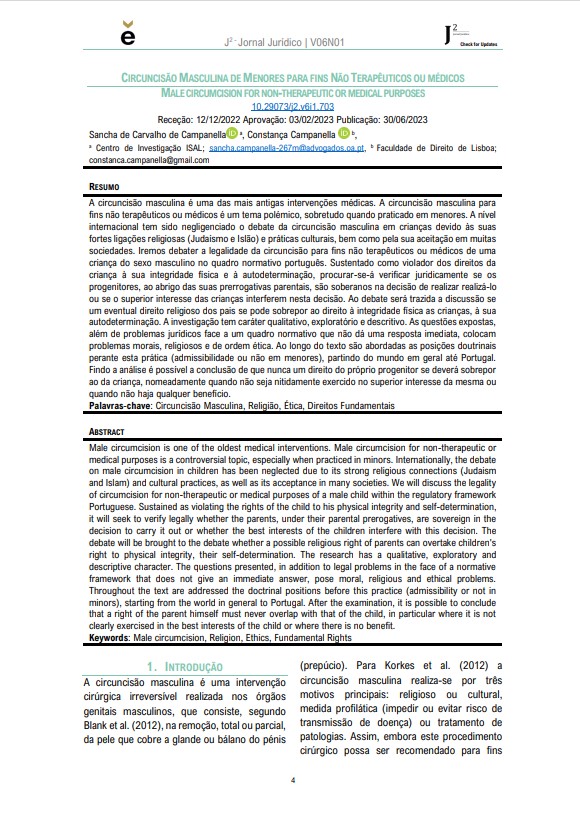
MALE CIRCUMCISION FOR NON-THERAPEUTIC OR MEDICAL PURPOSES
Article Sidebar
Main Article Content
Abstract
Male circumcision is one of the oldest medical interventions. Male circumcision for non-therapeutic or medical purposes is a controversial topic, especially when practiced in minors. Internationally, the debate on male circumcision in children has been neglected due to its strong religious connections (Judaism and Islam) and cultural practices, as well as its acceptance in many societies. We will discuss the legality of circumcision for non-therapeutic or medical purposes of a male child within the regulatory framework Portuguese. Sustained as violating the rights of the child to his physical integrity and self-determination, it will seek to verify legally whether the parents, under their parental prerogatives, are sovereign in the decision to carry it out or whether the best interests of the children interfere with this decision. The debate will be brought to the debate whether a possible religious right of parents can overtake children's right to physical integrity, their self-determination. The research has a qualitative, exploratory and descriptive character. The questions presented, in addition to legal problems in the face of a normative framework that does not give an immediate answer, pose moral, religious and ethical problems. Throughout the text are addressed the doctrinal positions before this practice (admissibility or not in minors), starting from the world in general to Portugal. After the examination, it is possible to conclude that a right of the parent himself must never overlap with that of the child, in particular where it is not clearly exercised in the best interests of the child or where there is no benefit.
Downloads
Article Details

This work is licensed under a Creative Commons Attribution 4.0 International License.


References
Blank, S., Brady, M., Buerk, E., Carlo, W., Diekema, D., Freedman, A., Maxwell, L., & Wegner, S. (2012). Male circumcision. Pediatrics, 130(3). https://doi.org/10.1542/peds.2012-1990
Bridge, Caroline (1999), Religion, culture and conviction – The medical treatment of youth children, Child and Family Quarterly, 11, p. 1-15
Cohen-Almagor, R. (2021). Should liberal government regulate male circumcision performed in the name of Jewish tradition? SN Social Sciences, 1(1), 1–26. https://doi.org/10.1007/s43545-020-00011-7
Código Civil , Decreto-Lei n.º 47344, publicado em Diário do Governo n.º 274/1966, Série I de 1966-11-25, com as respetivas atualizações, sendo a versão mais recente Lei n.º 8/2022, de 10/01, disponível em https://www.pgdlisboa.pt/leis/lei_mostra_articulado.php?nid=775&tabela=leis
Código Penal, Decreto-Lei n.º 48/95, de 15 de Março, com as respetivas atualizações, sendo a versão mais recente a Lei n.º 94/2021, de 21/12, disponível em https://www.pgdlisboa.pt/leis/lei_mostra_articulado.php?nid=109&tabela=leis
Constituição da República Portuguesa, Aprovada a 2 de Abril de 1976 pela Assembleia Constituinte, e publicada no Diário da República, Série I de 1976-04-10, versão consolidada disponível em : https://dre.pt/dre/legislacao-consolidada/decreto-aprovacao-constituicao/1976-34520775
Council, I. N. G. O. (2012). Violating children ’ s rights : Council on Violence against Children Harmful practices based on tradition ,. 48.
Council of Europe. (1950). Convenção Europeia dos Direitos do Homem. European Court of Humans Rights. https://www.echr.coe.int/documents/convention_por.pdf
Declaração de Genebra da Associação Médica Mundial, Adotada pela 2.ª Assembleia Geral da Associação Médica Mundial, Genebra, Suíça, setembro 1948, revista em outubro de 2017, pode ser consultada em https://ordemdosmedicos.pt/estatutos-e-regulamentos/#1504220526430-13f7b9b4-d898
Freitas, A. C. (2022). Circuncisão em bebés não reduz sensibilidade do pénis na vida adulta. Publico. https://www.publico.pt/2016/04/19/ciencia/noticia/circuncisao-em-bebes-nao-reduz-sensibilidade-do-penis-na-vida-adulta-1729409/amp
Gil, A. (2017). Como Elaborar Projetos de pesquisa. (E. Atlas, Ed.) (6a edição). São Paulo.
Korkes, F., Silva II, J. L., & Pompeo, A. C. L. (2012). Circuncisão por motivos médicos no sistema público de saúde do Brasil: epidemiologia e tendências TT - Circumcisions for medical reasons in the Brazilian public health system: epidemiology and trends. Einstein (Säo Paulo), 10(3), 342–346. http://www.scielo.br/scielo.php?script=sci_arttext&pid=S1679-45082012000300015
Mazor, J. (2013). The child’s interests and the case for the permissibility of male infant circumcision. Journal of Medical Ethics, 39(7), 421–428. https://doi.org/10.1136/medethics-2013-101318
McLaughlin Jr., P. J. (2016). The Legal and Medical Ethical Entanglements of Infant Male Circumcision and International Law. Journal of Medical Law and Ethics, 4(1), 23–38. https://doi.org/10.7590/221354016x14589134993938
Möller, K. (2020). Male and female genital cutting: Between the best interest of the child and genital mutilation. Oxford Journal of Legal Studies, 40(3), 508–532. https://doi.org/10.1093/ojls/gqaa001
Morris, B. J., Wamai, R. G., Henebeng, E. B., Tobian, A. A. R., Klausner, J. D., Banerjee, J., & Hankins, C. A. (2016). Estimation of country-specific and global prevalence of male circumcision. Population Health Metrics, 14(1), 1–13. https://doi.org/10.1186/s12963-016-0073-5
Neves, A. Brito, A Circuncisão Religiosa como Tipo de Problema Jurídico-Penal, 1ª Edição, Almedina, 2014
Pacto Internacional sobre os Direitos Civis e Políticos, Resolução 2200-A (XXI) da Assembleia Geral das Nações Unidas, de 16 de Dezembro de 1966. Aprovado em Portugal pela Lei n.º 29/78, de 12/06 publicada no Diário da República, I Serie A, n.º 133/78, disponível em https://www.cne.pt/sites/default/files/dl/2_pacto_direitos_civis_politicos.pdf
Pereira, André Gonçalo Dias Pereira, Direitos dos Pacientes e Responsabilidade Médica, 1ª Edição, Coimbra Editora, 2015
Pinheiro, Jorge Duarte, Limites ao exercício das responsabilidades parentais: em matéria de saúde da criança, 1ª Edição, Gestlegal, 2020;
Pinheiro, Jorge Duarte, Temas de Direito Pediátrico, 1ª Edição, Gestlegal, 2021;
Resolução n.º 1952 (2013) da Assembleia Parlamentar do Conselho da Europa, Disponível em: https://pace.coe.int/en/files/20174/html
Recomendação n.º 2023 (2013) da Assembleia Parlamentar do conselho da Europa, Disponível em: https://pace.coe.int/en/files/20176/html
Svoboda, J. S., Adler, P. W., & Van Howe, R. S. (2016). Circumcision is unethical and unlawful. Journal of Law, Medicine and Ethics, 44(2), 263–282. https://doi.org/10.1177/1073110516654120
UNICEF. (2019). Convenção sobre os Direitos da Criança e Protocolos Facultativos. Unicef, 1–80. https://www.unicef.pt/docs/pdf_publicacoes/convencao_direitos_crianca2004.pdf