
Same-sex affection in the 14th-century Portuguese court: A psychoanalysis of the case of Dom Pedro and Dom Afonso Madeira in “The Eunuch of Inês de Castro — Theatre in the Land of the Dead” by Armando Nascimento Rosa
Article Sidebar
Main Article Content
Abstract
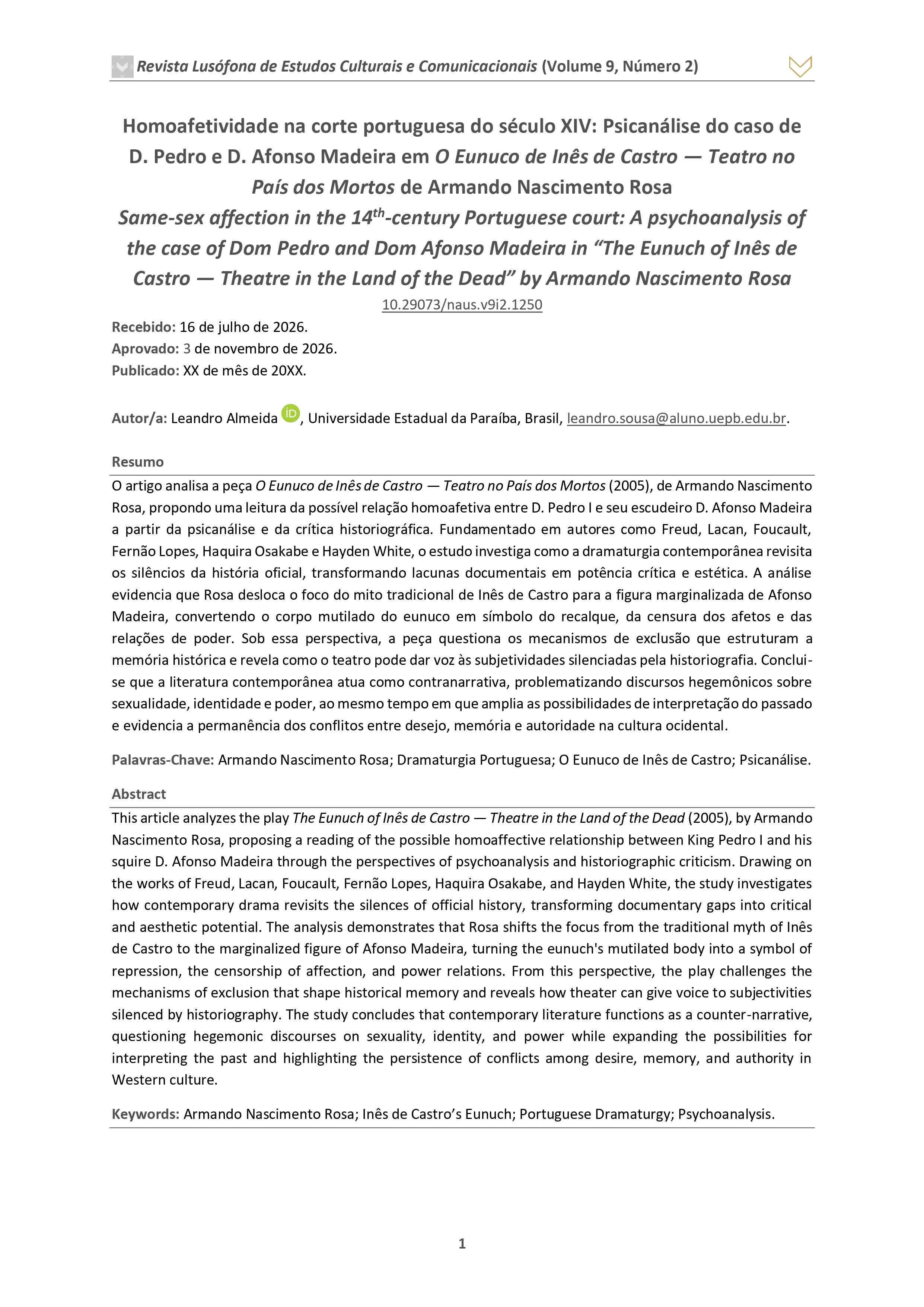
This article analyzes the play The Eunuch of Inês de Castro — Theatre in the Land of the Dead (2005), by Armando Nascimento Rosa, proposing a reading of the possible homoaffective relationship between King Pedro I and his squire D. Afonso Madeira through the perspectives of psychoanalysis and historiographic criticism. Drawing on the works of Freud, Lacan, Foucault, Fernão Lopes, Haquira Osakabe, and Hayden White, the study investigates how contemporary drama revisits the silences of official history, transforming documentary gaps into critical and aesthetic potential. The analysis demonstrates that Rosa shifts the focus from the traditional myth of Inês de Castro to the marginalized figure of Afonso Madeira, turning the eunuch's mutilated body into a symbol of repression, the censorship of affection, and power relations. From this perspective, the play challenges the mechanisms of exclusion that shape historical memory and reveals how theater can give voice to subjectivities silenced by historiography. The study concludes that contemporary literature functions as a counter-narrative, questioning hegemonic discourses on sexuality, identity, and power while expanding the possibilities for interpreting the past and highlighting the persistence of conflicts among desire, memory, and authority in Western culture.
Downloads
Article Details

This work is licensed under a Creative Commons Attribution 4.0 International License.
References
Almeida, L. S. (2021). Inês&Nós: Uma aplicação do método LerAtos na formação de professores leitores pela mediação do mito de Inês de Castro (Doctoral dissertation, Universidade Estadual da Paraíba). https://repositorio.uepb.edu.br/items/3781b0c2-8a46-42cc-8150-fc64395b0c11
Almeida, L. S. (2022). Remover pedras, desenterrar o futuro. In A. Andrade et al. (Orgs.), Inês&Nós: Trinta e uma novas histórias de Inês de Castro (pp. 37–39). EDUEPB. https://eduepb.uepb.edu.br/download/inesnos-trinta-e-uma-novas-historias-de-ines-de-castro/?wpdmdl=2259&masterkey=l4NNv2-qC2iiYrOjH_xFpTlvM8xtjtRNF2tg7CLCryQ56WynOXl0eefPujBcIZozJdEE3KHZIaMg2ZJcFyuXx9rhRrrPf70ryw4W5Zkv7zQ
Bessa-Luís, A. (1983). Adivinhas de Pedro e Inês. Guimarães.
Corradin, F. M. (2007). A paródia a sério da História: O Eunuco de Inês de Castro. Forma Breve, 5. https://proa.ua.pt/index.php/formabreve/pt/article/view/6745
Fonseca, G. (1957). Inês de Castro. Livraria São José.
Foucault, M. (1988). The history of sexuality: Vol. 1. The will to knowledge (Portuguese ed.: História da sexualidade [Vol. 1, A vontade de saber]). Graal.
Foucault, M. (2008). Discipline and punish: The birth of the prison (9th ed.; Portuguese ed.: Vigiar e punir: Nascimento da prisão). Vozes.
Freud, S. (2015). O inconsciente. In A interpretação dos sonhos e outros textos. Companhia das Letras.
Gil, A. P. (1975). Os grandes julgamentos da história: O processo de D. Inês de Castro. Otto Pierre.
Lacan, J. (2007). Os quatro conceitos fundamentais da psicanálise. Zahar.
Lopes, F. (n.d.). Chronica del Rey D. Pedro I. Biblioteca Nacional de Portugal. https://purl.pt/422
Osakabe, H. (1998). A pátria de Inês de Castro. In C. A. Iannone, M. V. Z. Gobi, & R. S. Junqueira (Orgs.), Sobre as naus da iniciação: Estudos portugueses de literatura e história (pp. 105–117). Fundação Editora da UNESP.
Rosa, A. N. (2005). O eunuco de Inês de Castro: Teatro no País dos Mortos. Casa do Sul.
White, H. (2014). Metahistory: The historical imagination in nineteenth-century Europe. Johns Hopkins University Press.